"For 10 years I was blind." The day Pürblack® founder stopped guessing
Seconds to get reports across six channels
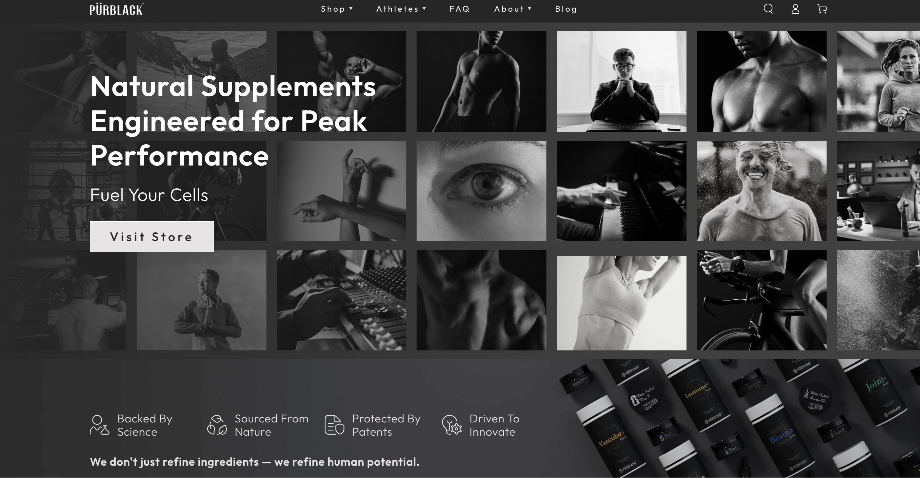
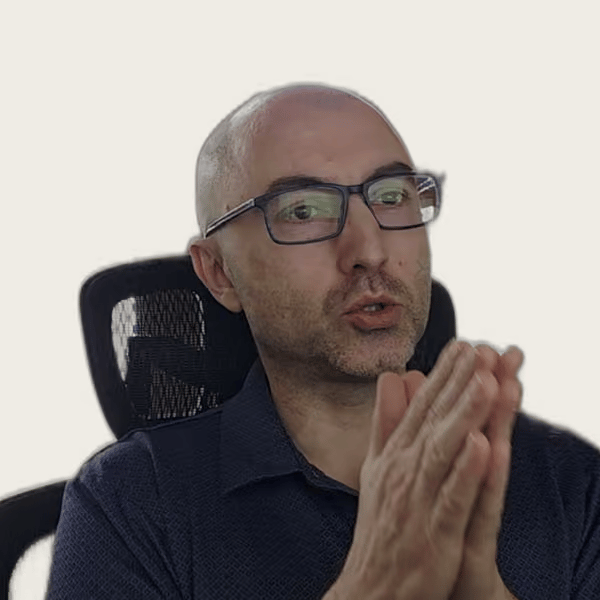
Nodari Rizun built a cult-favorite premium wellness brand, Pürblack® , on vision and gut. What he couldn’t build was a number he could trust – so his most important growth lever stayed hidden. Here’s how one source of truth, and an AI he could finally believe, changed how a founder decides.
At a glance:
- Company: Pürblack® – premium, science-backed wellness / longevity supplements, direct-to-consumer
- Who: Nodari Rizun, Founder & CEO · Mark Simmons, CMO (20+ years, ex-Coca-Cola, two published marketing books)
- The problem: six or seven marketing channels, zero single source of truth, and AI tools that hallucinated the numbers
- With OWOX: one source of truth they can trust – and the power to ask the business a question in Claude, through MCP
- The result: decisions in minutes instead of months, a quantified loyalty-growth lever they’d been missing, and – the founder’s word – time
Watch the conversation with Nodari Rizun and Mark Simmons: How Pürblack® built one source of truth (and 5-minute decisions).
Founders don’t hand out lines like that lightly. Nodari Rizun is a human-rights attorney by training and a PhD by temperament – and, by his own admission, “not a numbers person. I’m passionate, I’m creative, I’m guided by the spirit of the idea.” He built Pürblack®, a maker of premium, science-backed wellness / longevity supplements, into a brand whose customers describe it in a single word: advantage. For a decade, he ran it on instinct – because the numbers underneath it were never something he could trust.
This is the story of what changed when they became something he could.
A business whose economics depend on loyalty
A business whose economics depend on loyalty
To understand why the data problem hurt so much, you have to understand how Pürblack® makes money.
It sells direct-to-consumer, deliberately. “Nobody knows your product better than you do,” Nodari says, “so you should be talking directly – cutting out the noise and inaccuracy.” And it sells a premium product that works best taken every month, which means the business isn’t built on first orders; it’s built on repeat ones. A customer’s real value shows up over time, in subscriptions. Acquiring that customer is expensive; keeping them is where the margin lives.
So Pürblack’s entire engine rests on one question: are we turning buyers into loyal, recurring customers – and if not, where exactly are we losing them? Answering it well is worth a great deal. Answering it wrong, repeatedly, is the quiet way a good brand stalls.
The problem: a company flying on guesswork
The problem: a company flying on guesswork
Running that engine is Mark Simmons – a 20-year marketing veteran, ex-Coca-Cola, author of two books, at Pürblack® almost since day one. And for years, he was flying blind in a very specific way: he had data everywhere and truth nowhere.
Pürblack® ran across six or seven channels – Shopify for commerce, Google Analytics for behavior, Klaviyo for email, ad platforms on top. Each one reported its own version of reality, in its own dashboard, with its own definitions.
To answer a single business question, Mark’s team would pull five or six separate reports and try to reconcile them by hand – a process that took hours and produced, at best, an educated guess.
We had six or seven different channels and no single source of truth. It was almost impossible – a lot of guesswork.
Mark Simmons, CMO
They tried to buy their way out with an AI tool that promised to unify everything. It made things worse.
We tried a system like Windsor.ai to pull the data together. But there was a lot of hallucination, so it really wasn't that useful.
From the founder’s chair, the cost of that wasn’t a line item. Nodari describes it as something closer to despair – the sense of pouring money into advertising you can’t verify, scaling on numbers you don’t believe, and never quite knowing which of your decisions were real. The tax wasn’t only financial. It was every good idea that never got the clean data it needed to prove itself and grow.
The cost isn't money. It's broken dreams – ideas that never come to fruition, never get scaled. You become a hostage to your biases.
Nodari Rizun, Founder & CEO
He’d set an impossibly high bar and named it: golden data. “Golden data is clean data – the measure of reality, true and not false, that you can trust based on its source. If you have that, you’re good.”
He didn’t have it at that time. Almost no one of this size does – and most don’t even know it…
OWOX Data Marts
See your first report built in real time. 15 minutes.
- Connect your data warehouse
- Pick your metrics
- Get a live Google Sheets report
In the time it takes to write a ticket. Then imagine never writing that ticket again.
Book a DemoWe'll use your actual use case
What “trust” actually required
What “trust” actually required
Most companies never clear the bar Nodari set, and most don’t even know the bar exists.
Most businesses look at a Shopify or Google Analytics dashboard and think it's the source of truth. It's not – that data was never cleaned.
He has a name for the standard he was after – golden data: clean data that is a true measure of reality, trustworthy because of where it comes from and how it’s been prepared. Raw platform exports aren’t that. Neither is an AI that will happily generate a confident number it can’t stand behind. Nodari had watched cheap tools “promise the moon” and fail the only test that mattered: can I bet the business on this number?
That test – not features, not price – is what OWOX had to pass.
How it actually works (the part that makes the answers trustworthy)
How it actually works (the part that makes the answers trustworthy)
Here’s the architecture, because it’s the whole reason Pürblack® can trust what comes out.
OWOX doesn’t sit on top of raw exports and hope. First, Pürblack’s data analyst connects the data warehouse and publishes governed Data Marts – a single, approved definition of every metric that matters: what counts as revenue, what a “returned” customer is, how each channel is attributed, with the joins and quality checks baked in once. That library is the source of truth.
Then the AI layer sits on top of it, reachable from the tools the team already uses through MCP – the connection between OWOX and assistants like Claude and ChatGPT. When someone asks a question in plain language, the AI doesn’t invent a figure. It narrates over the SQL the analyst already wrote, against the governed marts. Every answer traces back to a definition the team approved – which is exactly why the hallucination risk collapses.
There's an AI layer on top that develops the insights – but we know the data underneath is solid, so the risk of hallucination is much, much smaller.
Nodari puts the same point more bluntly: the reason this AI is different is that it was built to be distrusted – with guardrails, not vibes.
AI, by its nature, will hallucinate. You need guardrails so you can trust your data. OWOX removed the AI hallucinations from AI.
The division of labor is the elegant part: the analyst governs what’s trustworthy once, and the whole company gets to consume it – without becoming a bottleneck, and without anyone downstream having to know SQL.
The payoff: ask your business a question, in the chat you already use
The payoff: ask your business a question, in the chat you already use
That architecture pays off as something that feels almost mundane in the moment and is anything but. The report that used to take an afternoon now takes a sentence.
Trust is the foundation. Speed is what you build on it. And this is the line that should stop every founder cold:
I can put a prompt in Claude, connected through our MCP, ask a question, and get almost instantaneous results from one single source of truth. Something that used to take a couple of hours – pulling five or six reports from Shopify, Google Analytics, Klaviyo – I now do in minutes. And I know it's going to be the correct answer.
No dashboard to open, no ticket in a queue, no waiting on an analyst to free up. A question in plain language, a decision-ready answer with a chart, every number traceable to logic the team approved. The mechanical work – pulling data and wondering whether it’s right – simply disappears, and what’s left is the actual job: deciding.
The growth lever they’d been missing
The growth lever they’d been missing
This is a definition worth millions, trapped in a founder’s head. This is where a trusted source of truth stops being a convenience and starts being money.
With clean, governed data, Pürblack® could finally model the economics of loyalty instead of arguing about them – and the picture that emerged was specific enough to act on.
New customers convert to a second purchase at a healthy clip – around 28%; whether someone comes back for a second order barely depends on the channel that acquired them. The leak was one step further down the funnel: only about 11% of returned customers went on to become loyal, subscribing ones.
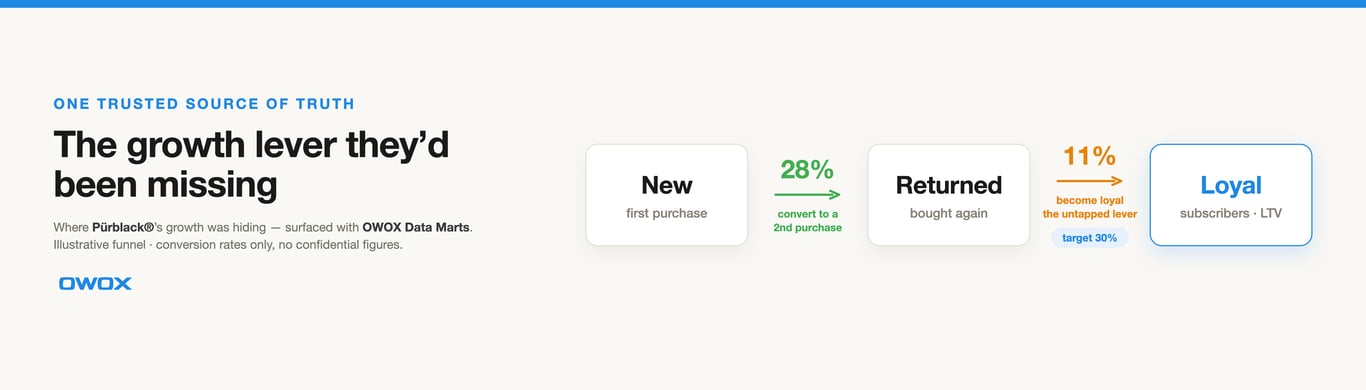
And that stage – returned-to-loyal – is precisely where a premium, best-taken-monthly product earns its lifetime value.
Naming that gap turned a vague instinct (“we should improve retention”) into a concrete plan: push returned-to-loyal conversion from ~11% toward 30%, fund it with one-time incentives rather than lifetime discounts, and evaluate acquisition channels by the cost of a new customer – because the second purchase largely takes care of itself. That’s not a hunch a founder defends in a meeting. It’s a lever with a number on it.
A loyal customer builds a solid foundation. If your foundation is solid, you can scale. If you can scale, you can build the future.
But the definition of a loyal customer – the single thing the whole company optimizes for – didn’t live anywhere the company could act on it. It lived in the founder’s head. Everyone else was guessing at it. That’s not a reporting gap; that’s the business’s most valuable model locked in one person’s mind, where no one else can run on it.
Why OWOX – because a tool that flatters you is worse than useless
Why OWOX – because a tool that flatters you is worse than useless
Nodari had watched the friendly, inexpensive tools fail the only test that counts. He’s scathing about them:
There are companies that, for a couple hundred dollars, will promise you the moon. The problem is: can you trust the data? They seem friendly, they sell you on the idea – and they don't deliver.
What set OWOX apart wasn’t polish or price. It was two things. First, it wasn’t a shiny wrapper on someone else’s numbers – it was built on real data engineering, the unglamorous work that makes an answer defensible. As Mark put it, “it’s not about bells and whistles… it’s based on a huge amount of data analytics and science.” Second, it didn’t flatter him – when he pushed on a number, it pushed back, investigating with him instead of defending itself:
When we challenge the data, OWOX questions it along with us – until we reach the source of truth.
The deeper problem wasn’t only bad data – it was who was shaping how he read it. For years his view of his own business had been filtered through agencies and ad-buyers whose interests weren’t his: they overpromised, underdelivered, and quietly framed the numbers in ways that kept the budget flowing to them. What he needed wasn’t just cleaner data – it was to get his own reality back.
…perceive reality as reality – and not a notion that in a manipulative way was forced onto our thought process.
The click, Nodari says, wasn’t a lightning bolt. “It was evolutionary – until it became revolutionary.” What tipped it was AI done right: guardrails instead of guesses. OWOX eliminated the corruption of the data and introduced truthful data – very quickly.
So, what’s changed?
Before, a single question was a project – hours of pulling and reconciling reports, and in the end a call made on gut.
Before, we decided on what an agency or a 'guru' told us, or on the brand name of the data provider…
After, the first change is felt daily. Decisions that used to wait on a report now happen in the flow of work.
It's so refreshing to make decisions based on data and insights rather than guesses. I spend my day developing insights and making informed decisions – not pulling data and wondering whether it's right.
Then came the sharper win. With one source of truth, Pürblack® could finally see where its loyalty economics were leaking – and put a number on the fix. The analysis pinpointed the single biggest untapped lever in the business: converting returned customers into loyal, subscribing ones.
New customers were coming back for a second purchase at a healthy clip; the real drop-off sat further down the funnel, at exactly the stage where Pürblack’s lifetime value is made. Not a hunch – a modeled opportunity with a plan attached.
Budget follows evidence now: Pürblack® can see which campaigns actually produce loyal customers and move spend toward them, and knows what to stop. And for Nodari, the CEO, the deepest change is the one that never shows up on a dashboard.
You start cutting through the noise. You start thinking differently.…Time is way more valuable than anything else – because time is the resource which doesn't come back.
The takeaway
Pürblack’s lesson isn’t really about a tool. It’s about a sequence most companies get backwards. They reach for another dashboard, or an AI bolted onto messy data, and wonder why they still don’t trust the answer.
Pürblack did it in the right order: build one trusted model of the business first – definitions, governance, control, in one place – and only then let an AI answer questions on top of it. Trust first, speed second. Get that order right and the payoff isn’t just tidier reporting; it’s the confidence to decide, and the lever you couldn’t see before.
Nodari compresses ten years into a sentence:
For 10 years, we couldn't get a source of truth. Now – literally in five minutes. What you can do now in five minutes, before you could not do in months.
A trusted source of truth, plus an AI you can actually believe, doesn’t just tidy the reporting. It hands a founder back the two things the fog was quietly stealing: good decisions, and the time to make them.
This is what it looks like to ask your business a question – and trust the answer. Book a walkthrough on your data →
Turn your data into decisions.
Governed data marts give you the clean foundation ML needs to actually work.
- No AI hallucinations
- Analyst-governed definitions
- Every number traces to SQL