

What Is dbt?
Data Build Tool is an essential open-source command-line tool that transforms data warehousing.
dbt allows users to craft maintainable and reusable SQL code, fostering collaboration by sharing with colleagues. It caters primarily to those who handle SQL daily, regardless of the size of their organization. It addresses common challenges such as disorganized code and repetitive programming by simplifying and streamlining the process of writing SQL.
Essential Facts about dbt (Data Build Tool)
As a powerful, open-source command line tool, dbt empowers analysts and engineers to use familiar SQL to handle complex data modelling tasks traditionally reserved for specialized ETL software.
- Core Components: dbt consists of a library of models (parameterized, versioned, tested, and documented SQL queries), an execution engine to execute models with various parameters, and a Command Line Interface (CLI) that orchestrates model execution.
- Open-source and Community-driven: dbt is not only free to use, but also supported by a vibrant community of data professionals who contribute to its continuous improvement and documentation.
- Integration with Modern Data Warehouses: dbt seamlessly integrates with modern cloud data platforms like Snowflake, Google BigQuery, and Amazon Redshift, enabling scalable and efficient data transformations.
- Streamlined Workflow: dbt’s workflow encompasses three core components: models, tests, and documentation. Models define data transformations, tests ensure data quality, and documentation provides a clear understanding of the data’s lineage and purpose.
Compatibility of dbt (Data Build Tool)
dbt (Data Build Tool) is renowned for its broad compatibility, making it a versatile tool in the data engineering landscape. It bridges the gap between data analysis and engineering, enabling teams to streamline workflows and enhance the precision of their data operations with ease.
- Tool Integration: dbt supports modern data platforms like Snowflake, Google BigQuery, and Amazon Redshift, facilitating seamless integration across various environments.
- User Flexibility: It is designed for data analysts and engineers alike, enabling those with SQL proficiency to perform data transformations efficiently. dbt is ideal for analysts and data engineers alike, facilitating reproducibility, collaboration, and streamlined management of complex analytics pipelines.
- Operation Mechanism: dbt functions by reading SQL scripts that define data transformations. It compiles these scripts into a comprehensive SQL query, which it then executes against a database.
- Extensible Framework: dbt allows for custom macros and plugins, expanding its utility and adaptation to specific data needs and workflows.
How Does dbt Help in Data Engineering?
dbt provides a robust framework for data engineers, significantly enhancing their ability to manage and optimize data workflows:
- Maintainable and Modular SQL: dbt allows engineers to write SQL code that is both maintainable and modular, promoting better organization and reuse of code.
- Scheduled Transformations: Transformations can be scheduled to run at regular intervals, ensuring data is consistently up-to-date and reducing manual workload.
- Automated Testing: Engineers can use dbt to implement automated assertions for testing models, enhancing the reliability of the data output.
- Data Profiling: dbt assists in profiling data to understand its characteristics, which is crucial for effective data management and usage.
- Collaboration: dbt facilitates collaboration among team members, allowing analysts and engineers to work together more efficiently on data projects.
Usage of dbt (Data Build Tool)
dbt (Data Build Tool) is widely used for its capabilities in transforming and managing data within warehouse environments. It simplifies data workflows, making it a vital tool for any data-driven organization. Here are key aspects of its usage:
- Data Transformation: Converts raw data into refined analytics-ready models using SQL, which are maintainable and easy to understand.
- Version Control: Integrates with version control systems to track changes and collaborate on data transformation projects.
- Automated Testing: Ensures the integrity of data through rigorous testing of models before they go into production.
- Documentation: Automatically generates documentation, helping maintain clear data lineage and providing insights into data transformations.
- Cloud Compatibility: Seamlessly works with cloud data warehouses such as Snowflake, Google BigQuery, and Amazon Redshift, facilitating easy deployment and scalability.
Real-world Examples of dbt (Data Build Tool)
dbt (Data Build Tool) offers powerful features that address common challenges in data engineering, such as version control, testing, and documentation. Here’s how different organizations effectively utilize these features:
Version Control with dbt: A Fintech Startup uses dbt integrated with Git to manage its financial models. Changes to data models are tracked through commits, and the team collaborates on updates, ensuring all modifications are reviewed and approved before deployment.
Testing with dbt: An E-commerce Company uses dbt to ensure the quality of its product data. By implementing dbt's built-in tests, such as uniqueness checks on product IDs and referential integrity tests between orders and inventory, they maintain high data accuracy.
Documentation with dbt: A Healthcare Analytics Firm utilizes dbt’s automatic documentation generation to make their complex data models accessible to all team members. This transparency helps the team in leveraging data more effectively for predictive analytics in patient care.
Extend Your dbt Workflows with OWOX Data Marts
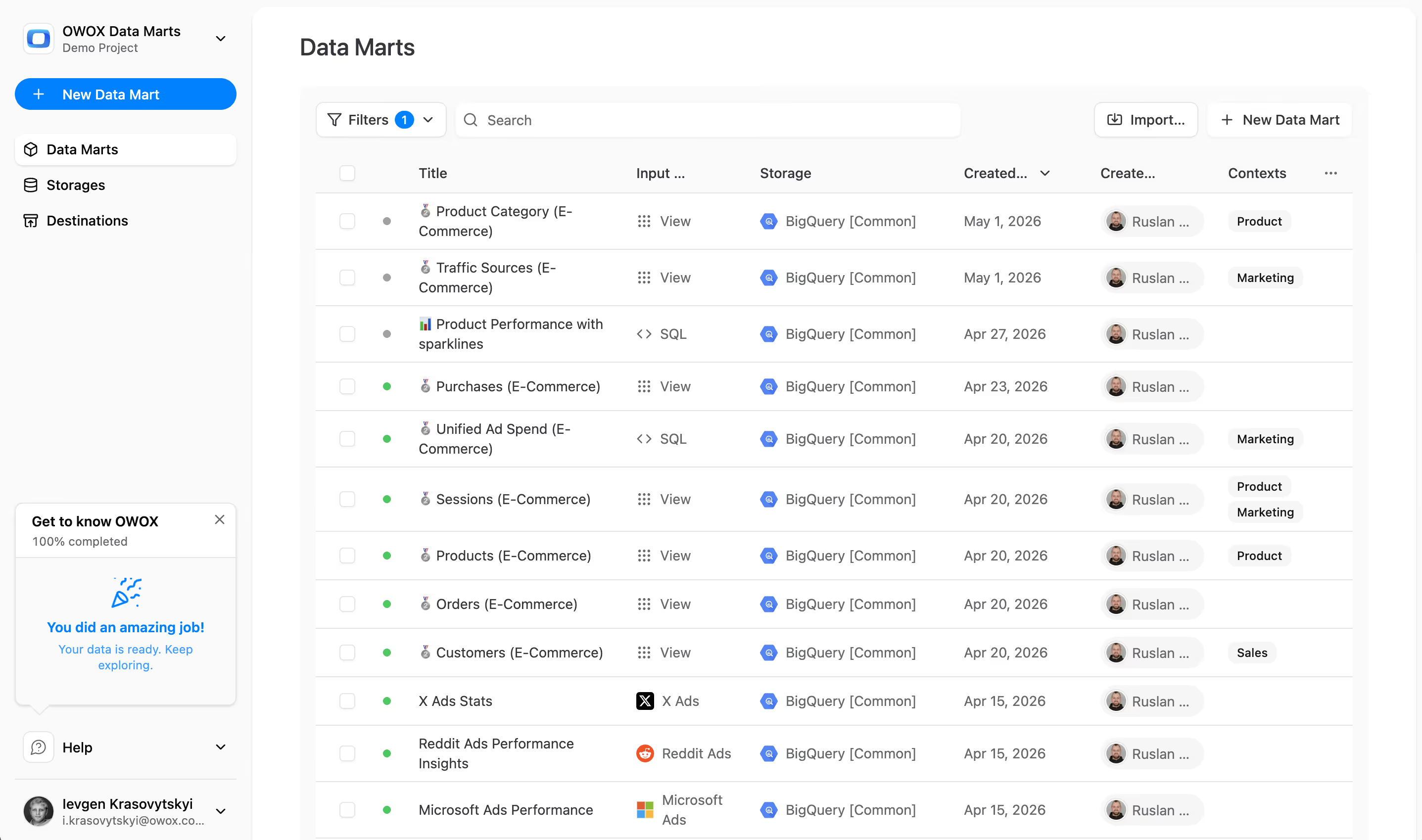
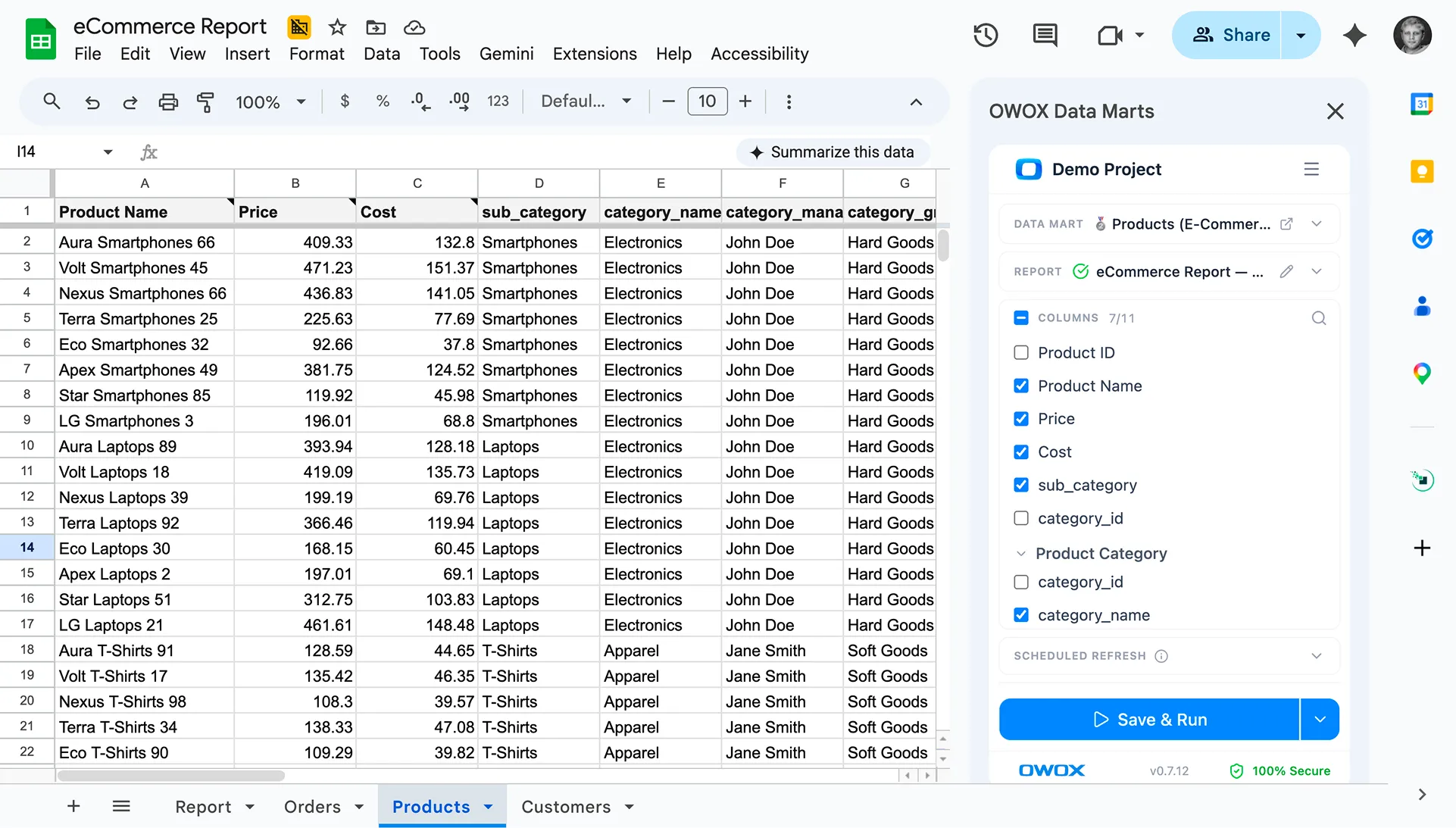
dbt helps you transform data through modular SQL models, but scaling those transformations for business users takes an integrated layer. With OWOX Data Marts, teams can reuse dbt logic, manage governed datasets, and automate delivery into tools like Google Sheets and Looker Studio.
It bridges data engineering and analytics, ensuring every model stays accurate, reusable, and business-ready.




Finally, a tool that doesn't ask business users to learn a new dashboarding UI. Our marketing team already knows Sheets. OWOX just delivers the right data.
Joinable data marts concept was the thing that sold us. We can now use the semantic layer without building one.
Self-hosted the OSS version on Digital Ocean. Zero vendor lock-in. Contributed a Shopify connector back in week two.